





|
|
|---|


Monday, September 13, 2010


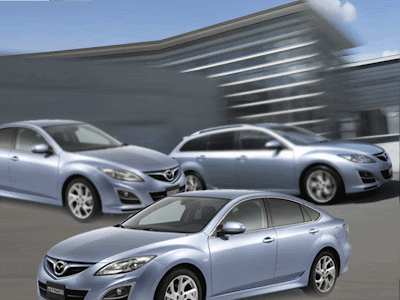
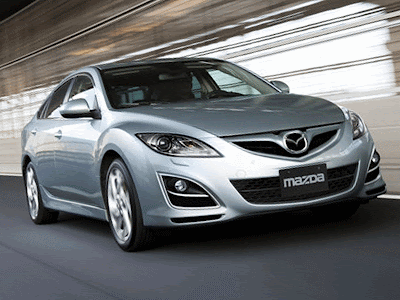
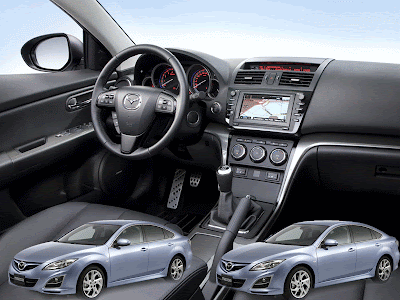
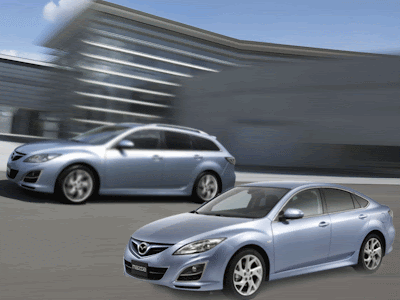
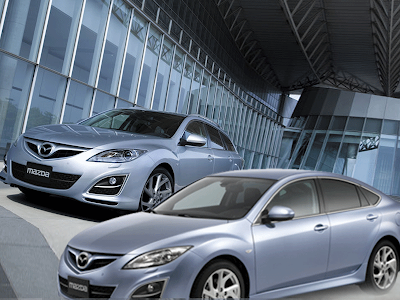
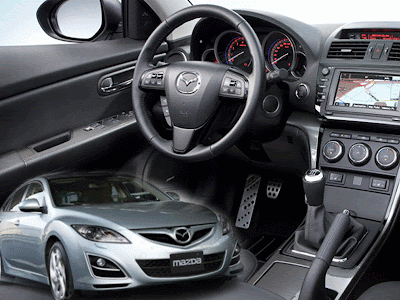
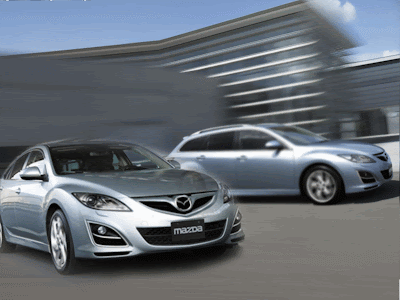
2010 Mazda Sport Cars Coupe Shinari Concept Car
Tuesday, March 9, 2010
Saturday, January 2, 2010
2009 Mazda Sports Car RX-8 Hydrogen RE vehicle with Norwegian specifications in HyNor
0 comments Posted by gun at 5:15 PM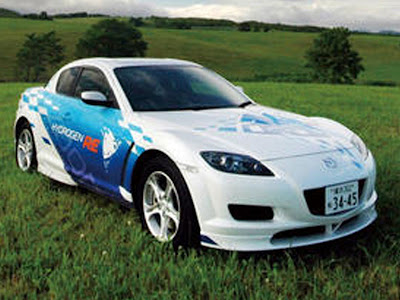 2009 Mazda Sports Car RX-8 Hydrogen RE
2009 Japan Mazda Motor Corporation (HIROSHIMA) announced that it has built the first Mazda RX-8 Hydrogen RE vehicle with Norwegian specifications, developed specifically for participation in HyNor, Norway’s national hydrogen project. The first unit will take part in ceremonies marking the official opening of HyNor’s hydrogen filling stations.
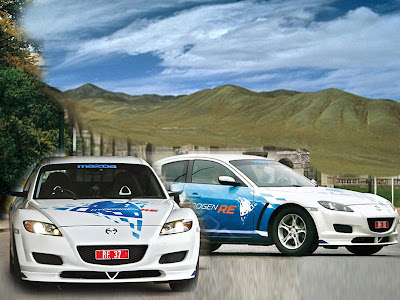 2009 Mazda Sports Car RX-8 Hydrogen RE
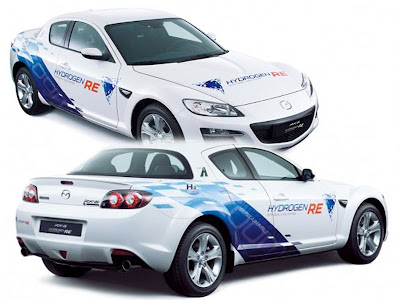 2009 Mazda Sports Car RX-8 Hydrogen RE
Unlike the RX-8 Hydrogen RE currently being leased in Japan, the HyNor-specification Mazda RX-8 Hydrogen RE is based on the latest European-specification Mazda RX-8 with left-hand drive and a manual transmission.
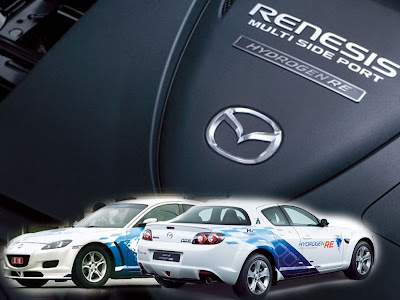 2009 Mazda Sports Car RX-8 Hydrogen RE
The HyNor project aims to enable hydrogen vehicles to travel along a 580-kilometer stretch of highway by establishing a chain of hydrogen stations between Stavanger and Oslo in Norway.
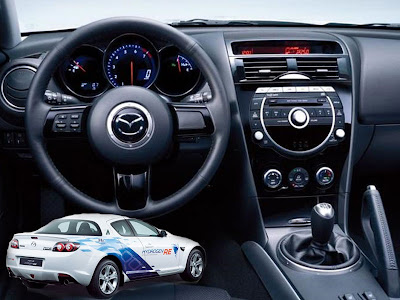 2009 Mazda Sports Car RX-8 Hydrogen RE
Mazda agreed to collaborate with HyNor on the project in November 2007 and began validation of the RX-8 Hydrogen RE’s driving performance on Norwegian public roads in October 2008.
Wednesday, November 11, 2009
Mazda RX-Z Concept 3.0 litre V6 and two electric motors Sports Car Coupe.
0 comments Posted by gun at 11:57 PM Mazda RX-Z Concept Sports Car Coupe
 The Mazda RX-Z concept is a proposal for a 2+2 sports coupe to replace the aging Mazda RX-8. The design was conceived by Andrus Ciprian, a design student from Romania whose previous work includes the Dacia MC concept. Like the MC the RX-Z concept was created using the 3d modeling program 3D Studio Max, and rendered with the help of Mental Ray.
 Mazda RX-Z Concept Sports Car Coupe
 The RX-Z was developed as Ciprian puts it; "as a link between fossil fuel cars and more ecological ones." To achieve this the proposed drivetrain for the concept includes a 3.0 litre V6 diesel engine up front - which replaces the notoriously thirsty rotary engine from the RX-8. And a pair of electric motors at the rear. Under normal conditions the RX-Z would be driven solely by the diesel engine. But at low speeds around town the electric drive can be used on its own for emission free motoring. At higher speeds the electric motors work in conjunction with the V6 engine to provide a boost function. A start/stop technology which is integrated into the engine further increases fuel efficiency.
 Mazda RX-Z Concept Sports Car Coupe
 One of the more unusual features of the Mazda RX-Z concept is the rear light panel. In the middle is a display screen which can light up with any text written by the driver. Presumably you can only 'write' on the back of your car when stopped, otherwise this would be one surefire way of either getting in a crash or getting in trouble!
Wednesday, October 7, 2009
Sky Concept The Mazda 2010 Featuring the next-generation Mazda SKY concept powertrain technologies and comprehensive advancements in weight reduction
0 comments Posted by gun at 11:29 AM Sky Concept The Mazda 2010
To make its Japan debut * Mazda Kiyora concept car, which achieves 3.1 l/100 km fuel economy.
Mazda’s theme for the 2009 Tokyo Motor Show is “The Mazda SKY concept – Providing driving pleasure and environmental and safety features for all customers!” Under the headings of “Today,” “Tomorrow” and “The Future,” Mazda will display advanced technologies designed to improve the average fuel economy of Mazda vehicles sold globally by 30 percent before 2015 compared to 2008 levels. This is one of the goals of Mazda’s long-term vision for technology development, Sustainable Zoom-Zoom.
The SKY concept embodies Mazda’s desire to ensure an “everlasting blue sky” under which drivers will always be able to enjoy the pleasure of driving afforded by owning a Mazda. The concept also reflects the “sky’s the limit” aspirations of Mazda’s engineers as they employ unconventional thinking to achieve optimal performance in every vehicle that bears the Mazda nameplate.
Mazda is committed to significantly improving the core aspects of its vehicles that affect performance – engines, transmissions, and lighter vehicle weight – in order to achieve elevated driving pleasure together with outstanding environmental and safety features. The Mazda SKY concept defines Mazda’s approach to developing next-generation powertrains that will significantly improve the eco-friendliness and dynamic performance of all Mazda vehicles.
Based on the SKY concept, Mazda’s “Technologies for Tomorrow” display at this year’s Tokyo Motor Show will include the next-generation direct-injection petrol Mazda SKY-G engine and the Mazda SKY-D clean diesel engine. Both offer improved eco-friendliness and torque thanks to optimised combustion efficiency. Mazda will also reveal its first next-generation automatic transmission, the Mazda SKY-Drive, which offers first-rate fuel economy and a direct driving performance feel
Alongside the SKY concept exhibits, Mazda will also feature a “Today’s Technologies” exhibit that includes i-stop, a unique idling stop system that was introduced with the all-new Mazda3 (Axela in Japan). “Future Technologies” will showcase the advanced Mazda Premacy Hydrogen RE Hybrid, with its hydrogen-powered rotary engine, and various vehicle technologies under development as part of Mazda’s drive to realise an accident-free and safe motorised society.
Thursday, October 1, 2009
 Mazda MX-5 Roadster Sport Concept Car
Mazda Superlight equipped with a standard four-turbocharged engine of 1.8 liter capacity 126 hp, maximum torque is equal to 166 Nm. Acceleration 0-100 km / h in 9.2 seconds with the concept. Roadster received 17-inch wheels with tires of dimension 205/45, Bilstein shock absorbers and springs Eibach.
Friday, February 15, 2008

Our year with the Mazda RX-8 was like spending time with young children: deeply rewarding most of the time but occasionally very frustrating and annoying.
Let's get the bad part out of the way first. The RX-8 is the first U.S.-market car to usea Wankel rotary engine since the Mazda RX-7 departed our shores after 1995. The rotary has a number of advantages over a reciprocating engine-notably its compactness, its simplicity, and the lack of moving parts that allows it to rev higher. But as with most things in life, you don't get something for nothing, and there are also a number of problems with rotary engines. First, they aren't very thermally efficient, which means they're thirsty for petrochemical products. We found the RX-8 guzzled premium gasoline at a rate of 19 mpg during its 34,305 miles with us.
Rotary engines also like to consume oil, because they use this particular hydrocarbon to lubricate rotor seals on a total-loss basis. The manual warns owners that they will need to check the oil level every couple of fill-ups, but it's odd to have to do that in this day and age-it reminded us of owning an old British sports car. It's not as if Mazda makes the task easy, either, as senior editor Joe Lorio observed: "For a car that needs such close monitoring of its oil level, its dipstick sure is buried. And should you actually need to add a quart of oil, you must first remove the engine cover. Now, that's convenient."

We probably wouldn't have cared too much about the RX-8's sheik-friendly ways, except that there was another problem. The car didn't like cold mornings. We're not fans of them, either, but we don't lie down and give up when the thermometer drops. We had to call Mazda's roadside assistance no fewer than three times when the rotary failed to start in winter. Jump-starting it worked once, but twice it was hauled away to our local dealer on a flatbed. Online editor Mike Dushane, savvy about the RX-8's aversion to the cold, parked it facing downhill so he could push-start it, which came in handy once.
It transpires that the Renesis 13B rotary is prone to flooding if you fire it up and then shut it down before it gets up to operating temperature. The RX-8's manual specifically states that you should warm up the engine in really cold weather-0 degree Fahrenheit or lower-and use minimal throttle for starting. Once the engine is flooded, Mazda advises flooring the gas (which shuts off the fuel pump) or using no throttle at all.That sounds fine in theory, but in practice, our car just didn't respond to those wiles. One really cold afternoon, the car stalled when the traction control cut in while we were reversing out of a snowy driveway. We tried everything to restart the car, but it wouldn't fire up. To exacerbate the annoyance, getting to the battery terminals was a giant pain in the fingers, thanks to the aforementioned cover that must be removed for access to anything on the engine.

The starting problem wasn't unique to our car, as both Mazda and Internet chat rooms acknowledge. Mazda says that, weirdly, only some cars have been affected by cold-starting woes, which the company has partially redressed by changing the spark plugs and retrofitting batteries with more cranking power.
Our RX-8 also spent plenty of time at the dealership because of numerous check-engine-light issues, including a stuck thermostat, a wiring problem with the stability control switch, and a catalytic converter that died because its shield had failed. We also had to replace warped front brake rotors at 12,156 miles, which the warranty covered.
It was a shame the car let us down so often, because it is otherwise a terrific package and felt as solid at the end of 34,000 hard miles as it did when it was delivered.

The RX-8's unique selling proposition-that it's a four-door sports car-is certainly one of its most appealing features. The short suicide doors provide far better access to the rear seats than sliding the front seats forward in a conventional two-plus-two coupe. The rear seats are excellent for small kids and acceptable for adults on short trips. "During a weekend of wandering around Michigan," noted Web intern Stuart Fowle, "there were no complaints from my back-seat passengers about the space."

What red-blooded American automotive journalists would admit in the pages of a car magazine that they drove to the beginning of one of the most spectacular roads in these United States, saw the 35-mph speed limit, and found it didn't bother them?
Call me a girl, which only means I'll be brave enough to write that gentle motoring has a place in our hectic world, that it can even be alluring. Depending, of course, on the transport. And, of course, on the locale.
We've come all the way to the Big Island of Hawaii (4038 square miles) to stare into the ocean's depths at dawn and ride at dusk to the top of Mauna Kea (13,796 feet), lifted up into a heaven packed with more stars than we've ever seen in our lives. In between, we'll fling the top back on the planet's most popular roadster and drive through a goodly number of the eleven microclimates on the island. By the time we get to that perfect road, Highway 250 north out of Waimea to Hawi, we're packing some major aloha-that's "love" to you haoles-and feeling as if our groove has come all the way back from the flatline we've been feeling after a long, rainy month on the mainland.

No, the all-new Mazda MX-5 is nothing like the ass-kicking Porsche Boxster S. Yes, it does have a lot more horsepower than it had, though not an overabundance of same-170 with the five- and six-speed manuals and 166 with the six-speed automatic transmission, up from 142 last year. It has slightly more room for longer torsos, thanks to a 0.6-inch-taller windshield header, a seatback with another degree of rearward travel, and a new tilt steering column. There's 2.2 inches more hip room, as well as enough extra cargo space for another grocery bag or two (plastic, not paper). The body feels tighter, thehandling nimbler, the chassis sturdier, and the steering more responsive. It looks fresher, a bit edgier from the sidewalk, more luxurious and more richly appointed from behind the wheel.
Not so much as a nut, a bolt, or a switch has carried over from the second-generation Miata-not even the name. And yet the most important element has not changed-that would be, simply, driving fun.
The perfectly executed two-seater that began the revolution in late 1989, spawning the Mercedes-Benz SLK, the Porsche Boxster, the BMW Z cars, and now the Pontiac Solstice, remains true to its roots. "Jinba ittai," they say in Hiroshima. The synergy of rider and horse moving as one. Manly automotive journalists don't go around talking about jinba ittai, no matter how perfectly it expresses the very soul of the Miata. It might be easier to embrace a more freewheeling interpretation, delivered in the quaint syntax of our Japanese friends at Mazda as the "lots of fun concept." Who can't appreciate lots of fun?

MX-5 program manager Takao Kijima, who has spent more than a third of his life on the Miata, explains that the engineering focus was not on direct measures such as performance and quality achievements but rather on "intangible virtues such as pleasure, beauty, and emotional attachment." Instead of 0-to-60-mph acceleration statistics, the Miata engineers felt it was more important to understand "how the car feels through the driver's sense of touch, how it sounds at speed, how it looks with the top folded, and what pleasant scents can be enjoyed during a spring drive."
Despite the fact that I've pushed the idea of the simple, lightweight roadster to the wall with my very own lusty 178-hp, turbo-charged 2005 Mazdaspeed version of the Miata, Big Island driving makes it easy to embrace the lots of fun concept. Only a handful of roads circle and straddle this still wild, volcanic paradise. One is more heavily pa-trolled than the next by a zero-tolerance police force lurking in their own personal cars and trucks behind the 25- and 35-mph speed-limit signs found on every single road of note. None fast, all fun. A flick of the steering-wheel-mounted cruise-control switch preserves our driving record-for now.

Do you have the patience to hear about one more SUV? How about one of those annoyingly nebulous SUV/crossover/whatever vehicles? At the risk of having you turn the page right now, we'll tell you that the new Mazda CX-7 is an SUV-like thing that tries to be sporty. We know, you've heard that before, with the BMW X5 and X3, the Infiniti FX45, the Porsche Cayenne, the Jeep Grand Cherokee SRT8, and some lesser lights as well.
Look past the obvious-the RX-8 wannabe front fenders, the hop-up windowline, and the bulging rear wheel arches-and you notice that, unlike every other entry in this overcrowded field (save perhaps the FX45), the CX-7 has not a single flat plane anywhere on its body. The front end is radically swept back, the windshield sports the fastest rake in its class, the roofline takes a dive aft of the B-pillars, and even the greenhouse features some major tumblehome and tapers in toward the rear. This thing isn't just styled, it's shaped.

The CX-7's engine is equally radical. Borrowing the Mazdaspeed 6's direct-injection, 2.3-liter turbo four-a high-strung engine with an all-or-nothing, turbo-dependent power delivery-and pairing it with a manu-matic transmission sounds like an absurd choice for SUV duty. After driving the CX-7, we'd say it's merely unusual. In this application, the engine has traded away 30 hp and 22 lb-ft for improved driveability, yet it's still able to push the CX-7 along with verve while returning semirespectable economy ratings of 18/24 mpg (with all-wheel drive). But the throttle response is hardly linear, and the engine note will never be mistaken for the smooth spin of a good V-6.
The CX-7's sporty chassis tuning suffers no such downside. Its most immediately endearing quality is the steering response, which is direct, linear, and nicely weighted. SUVs that don't heel over in corners are no longer a novelty, but even in those vehicles you're keenly aware that a lot of weight is riding way up high. The CX-7 is a bit lower and lighter (under two tons, anyway), and it manages to escape that high 'n' heavy feeling.

Naturally, the CX-7 isn't quite as roomy as some of the boxier entries, even though it's longer and wider than the Mazda Tribute, and there's no third-row seat. (That's coming in the CX-9, which was recently unveiled at the New York auto show.) The CX-7's below-the-windowline cargo space is reasonable, but its tapered greenhouse and sloping roofline cut into maximum capacity. If hauling stuff is your priority, you have a herd of more suitable SUVs to pick from. The CX-7 instead makes a case for itself as a tall, sporty wagon-and, for less than $30,000 (exercising a modicum of options restraint), it's notably cheaper than the other sporty crossovers at the auto mall. That's how you wedge your way into an overcrowded field.
The CX-9 shares the same gaggle of parts as the Ford Edge, but it's been engineered as a seven-passenger vehicle, so the Mazda's wheelbase has been stretched 2.0 inches and the vehicle is 13.9 inches longer overall.
The CX-9 is a great people package. The second-row, 60/40-split bench seat slides back five inches and also reclines, and there's a single release lever to expedite access into the third-row, 50/50-split bench seat. An optional rear-seat DVD system keeps passengers entertained, while the air-conditioning is powerful enough to sustain a breeze all the way to the back. Both rear seats fold down flat when it's time to visit the Home Depot. Even better, the interior of the Grand Touring model mixes color and trim in a cool, sophisticated way that even the Lexus RX350 can't match.
Mazda's new people mover also meets carlike standards of safety. The canopy air bag protects all three rows of passengers from head injury, while ABS, electronic brake assist, and stability control are standard. Like the Edge, the CX-9 features Ford's Volvo-engineered, antirollover stability system with twin sensors to monitor body roll and yaw. Also like the Edge, all-wheel drive is optional.
Best of all, the CX-9 drives like a Mazda, not some soggy station wagon. The long, 113.2-inch wheelbase helps deliver a stable ride, firm suspension bushings produce surprisingly crisp steering response (although at the price of some thumping over bumps), and the Grand Touring model even gets twenty-inch wheels. Moreover, the six-speed automatic (from Aisin, not Ford) has such refinement that you feel only the 263 hp of the Ford-supplied 3.5-liter V-6, not the shifting.
The Mazda CX-9 is what the American car has become in the twenty-first century. It's in the middle of the fastest-growing segment in the car industry, and that's why there are some forty-three similar crossover utility vehicles on the market right now, with a total of seventy expected by 2009.


