





|
|
|---|


Wednesday, August 4, 2010


Friday, July 16, 2010


Thursday, July 1, 2010
2010 Renault Modus Evian Masters Limited Edition - Renault Cars
0 comments Posted by gun at 11:14 AM


Sunday, May 23, 2010


Monday, May 17, 2010


Sunday, February 7, 2010
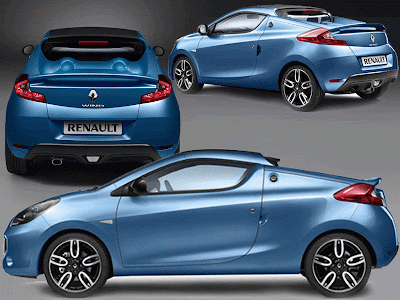
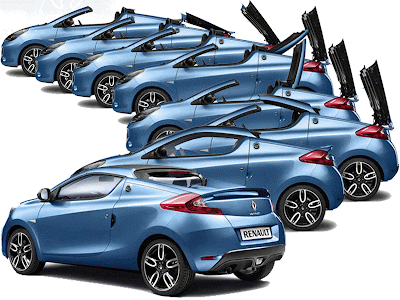
Renault announced its plans to unveil the brand-new Wind coupe-roadster at the upcoming Geneva Motor Show 2010 on 2 March. The 2011 Renault Wind is designed for two persons. Despite the fact that Renault pitches the car as a coupe-roadster, unlike other CC models with retractable hardtops, the Wind uses an exclusively innovative electric roof that rotates 180 degrees into the trunk, which is capable to open in just 12 seconds.
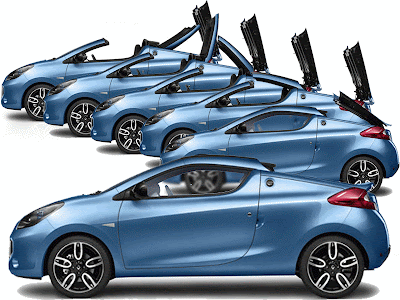
Renault Wind brings a completely different take on a car for drivers who enjoy wind-in-the-hair motoring. Renault Wind is aimed at motorists who lust after a car that is not only distinctive and compact, but also convertible yet practical enough for everyday use.
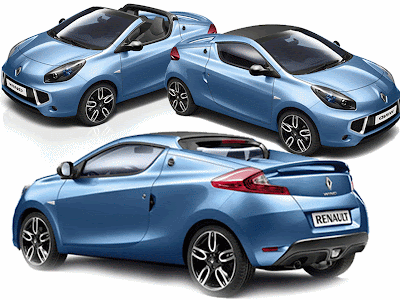
Advantages of this car is the only car of its class to provide just as much luggage space (270dm3 VDA) whatever the position of the roof. The Renault Wind has a 3.83 metres in length which features a highly innovative way of opening up. The strictly two-seater model shares its platform and mechanical hardware with the Twingo, though at 3.830mm long, it's 230mm longer than the hatchback.
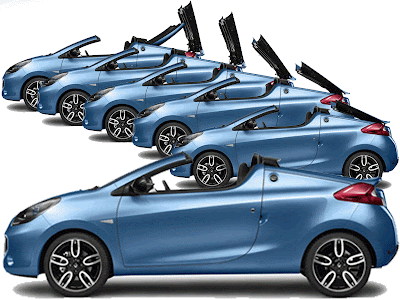
The French automaker is keeping a tight lid on other details for now, but it is expected that the Wind will be offered with two of the Twingo's petrol engines, a 1.2-liter turbo with 100HP and a naturally aspirated 1.6-liter unit with 133HP.
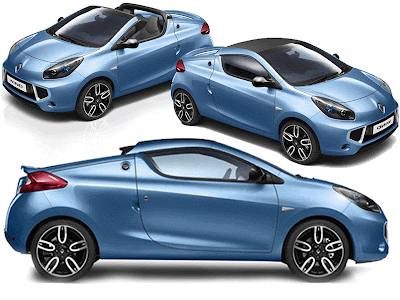
Although Renault Wind’s compact dimensions make it a nimble machine in and about town, it is the only car of its class to provide just as much luggage space (270dm3 VDA) whatever the position of the roof. True to Renault's brand signature "Drive the Change", Wind makes passion affordable for everyone.
Thursday, October 1, 2009
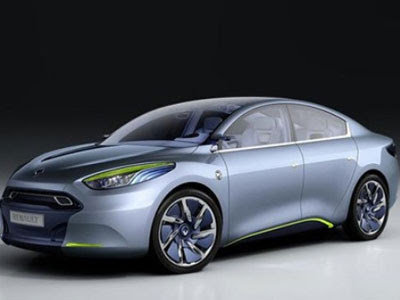 Renault ZE Electric Concept Sport Car
Renault introduced at the Frankfurt Auto Show, four electric vehicle concept, of which the closest to mass production Fluence ZE model.
Budget Fluence sedan got a new design, 95-hp electric motor and battery lithium-ion batteries, which is enough for 160 kilometers. Charge can be within 4-8 hours, the fastest way for 20 minutes or be replaced by a charged battery on a special stand for 3 minutes.
Electric car plan to release to the markets of Europe and Israel in 2011, when the lithium-ion batteries will become available and the Government will develop a discount program for the purchase of electric vehicles.
Tuesday, September 29, 2009
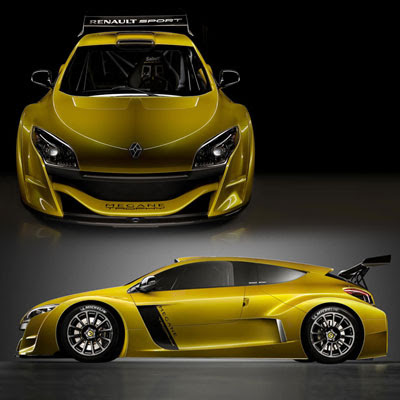
The 2009 Renault Megane Trophy is based on the new Megane Coupe which is powered by the Renault-Nissan Alliance’s mid-rear 3.5-liter V6 24V engine that produces 360 hp.
The front and rear light units and windscreen are from the Megane Coupe road car while flowing lines of the bodywork was designed from digital simulation technology to improve the aerodynamic.
The Renault Megane Trophy features front splitter which channel air flow to the extractors and rear diffuser and wing that generated downforce. Downforce has improved by 20 % with the refinements to the set-up and drag was reduced by 15 % , which together, represent a gain of almost 40% in terms of the new car’s aerodynamic performance over the previous generation vehicle.
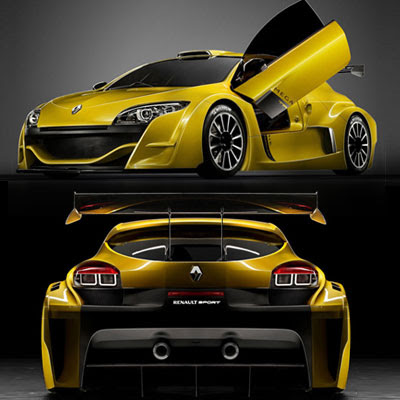
Apart from that, the Megane Trophy also features butterfly doors reminiscent of the world of GT and sports-prototype racing. The V6 3.5 24V engine is mated to a semi-automatic gearbox with the same mechanical features as the current car, including an FIA-homologated sports-prototype tubular chassis, steering wheel-mounted paddle shift, double wishbone suspension with adjustable dampers, 18-inch wheels and Michelin tires.
The power of the standard 330 hp engine was boosted to 360 hp with the help from the new inlet manifold. Rebuild is still at every 5,500 km for the car’s reliability. According to Renault, with the new aerodynamic gains, the extra power from the engine will enable the 2009 Renault Megane Trophy to lap in similar times to those of a Porsche GT3.
Sunday, February 24, 2008
To Americans, Renault is synonymous with bad quality and lousy reliability. These days, however, la Regie is responsible for some stylish and thoroughly well engineered cars, which are as reliable as anything on the European market and nicely screwed together, too.Whatever one thinks of the exterior of the Megane II hatchback—and we rather like the formal proportions to the hindquarters that remind us of a 1920s limousine—the interior is superbly wrought. Indeed, the soft-touch plastics that swathe the dashboard and center console and even surround the window lifts and door pulls are up to Volkswagen standards and make most of the small cars on sale here, whether from Japanese or domestic manufacturers, look decidedly cheesy. Sure, we were driving the upscale Privilege trim level, which costs the equivalent of $20,000 without the British sales tax of 17.5 percent, but all Meganes have the same elegant interior architecture and high grade materials. There's some suitably quirky Frenchness, too, with a flat card taking the place of a key: slot it into a hole in the center console and then hit the Start/Stop button to get going.
The Megane is sold with 1.4-, 1.6- and 2.0-liter gasoline engines as well as 1.5- and 1.9-liter common-rail diesels. The diesels are the nicest to drive, with the 1.9-liter four making 118 horsepower and an amazing 221 pound-feet of torque at an equally astonishing 2000 rpm. All that low-down lugging power ensures the Megane 1.9dCi covers ground remarkably swiftly, aided by a very sweet six-speed manual. Top speed is 122 mph, 0-62 mph is claimed to take 10.5 seconds, and real-world overtaking is remarkably easy. The engine is super smooth and quiet, too: We'd reckon that nine out of ten Americans wouldn't be able to tell what type of engine this is. Better still, in a place where fuel costs $5 a gallon, real world fuel economy of around 40 miles per (U.S.) gallon makes a huge amount of sense.
It's not all good. The Megane is a great highway cruiser, but once the road starts twisting and the surface starts breaking up, the car's MacPherson strut front and rear torsion beam suspension can't quite cope. The car tends to float too much over crests and suffers from lateral motions on bumpy back roads, while the steering is a touch inert. The chassis is competent and the car can be hustled rapidly and safely, but it's hardly inspirational.
Would the Megane catch on in the States? In Privilege form—with power locks and windows, steering column radio controls, automatic air, et cetera—it costs about the same as a well equipped VW Jetta or Golf. It isn't any more entertaining to drive, but is more stylish inside and out and would be a great freeway ride or city commuter. Whether anyone at Renault really wants to try out the American market again is a moot point-and with Nissan doing so well, why bother? What we really like about the Megane, though, is that its design team, led by the underrated Patrick Le Quement, has really managed to come up with a distinctly national style in a way that the multicultural design teams at other major makers-GM and Ford in the U.S. among them-have failed to do.


[
Lyon, France - Imagine a widebody Dodge Neon coupe. Mid-engined. Rear-wheel drive. No longer powered by a humble four-cylinder but by a V-6 borrowed from the 300M. Get the picture? That's essentially the transformation Renault's Clio econo-hatch has undergone at the hands of Renault Sport and Tom Walkinshaw Racing (TWR). The result is the awesome Clio V6, son of the Renault 5 Turbo 2 and Renault's newest racer for the road.
The Clio V6 comes together at TWR's facility in Uddevalla, Sweden, where serious structural reinforcements are required before an engine can be planted in the middle of the car. While they are at it, the Anglo-Scandinavian welding artists stretch the wheelbase and widen the track, front and rear. The suspension is also all new. Up front are damper struts and lower wishbones, with longitudinal and transverse links at the back, abetted by compact spring and damper units. Thick anti-roll bars and four large vented disc brakes complete the chassis setup. Although the doors and fenders are composite, the Clio V6 still tips the scales at a sumo-esque 2955 pounds.
Like its charismatic predecessor, the genetically manipulated Clio does not share many items with its mass-production siblings. Under the hood, where lesser Clios have their engine and transmission, the Clio V6 has a black plastic tray that serves as a bonsai cargo hold. The engine instead looms large behind the front seats. Although sealed off by a well-insulated clamshell capsule, the 24-valve V-6 is still every bit as audible as an angry mother-in-law riding shotgun. Mounted east-west, the 3.0-liter engine, which produces 230 horsepower and 221 pound-feet of torque, is mated to an extremely long-legged six-speed manual transmission. With the exception of anti-lock brakes, there are no electronic watchdogs to aid traction or to sort out any handling imbalance. On grippy tarmac, the wild-looking Renault will accelerate from 0 to 62 mph in 6.4 seconds. The top speed is an even more impressive 147 mph, although it takes a long time to get there. Fuel economy? About 16 mpg.
Visually, the Clio V6 is an absolute treat. The designers created a much more sensuous and sculptured body with prominent lateral air intakes, a massive front spoiler, flared front and rear fenders, sills that are now almost too wide to step over, multi-lens headlamps with xenon bulbs, and a busy rear bumper that incorporates two rectangular breathing gills and a pair of enormous tailpipes. The alloy wheels are shod with well-filling Michelin Pilot Sport SX tires--205/50ZR-17 front and 235/45ZR-17 rear.
Inside, however, the mid-engined Clio is definitely more Renault than Sport. The plasticky dashboard is almost unchanged, and the build quality is more in line with a $15,000 runabout than with a $34,000 hot hatch. Strong points include the comfortable and generously adjustable seats, the conveniently tall shift lever, and the perfectly spaced drilled metal pedals.
Ready for a blast around the block? Then brace yourself for some serious initial understeer. Directional stability can be best described as sporadic, and at-the-limit handling is a take-your-heart-in-your-hands experience. Power oversteer is the essence of this car's character, but you need to plant your right foot quite early to unstick the rear tires, and, occasionally, it helps to point the nose toward the apex of a turn even before you can see it. What can really throw you on winding roads is the extra-wide turning circle and the steering's lack of lock, both of which must be blamed on serious front-end packaging constraints. On the credit side, the Clio V6 deserves full marks for a set of powerful disc brakes and for its intoxicating drivetrain, which is smooth, torquey, responsive, and unexpectedly refined.
Renault Sport and TWR will build no more than 5000 Clio V6s through September 2003. Since orders already exceed the limited supply, the cars are being allocated to preregistered customers via an Internet raffle.
Perhaps DaimlerChrysler should consider a similarly tricked-out Neon. After all, such a car works wonders for the corporate image--and for the adrenaline flow of its lucky owners.


